loading icon

Encapsulation − Mappemonde − The Secret Book

George
Lappas
Encapsulation − Mappemonde − The Secret Book
November 29, 2018 - May 31, 2019
Athens

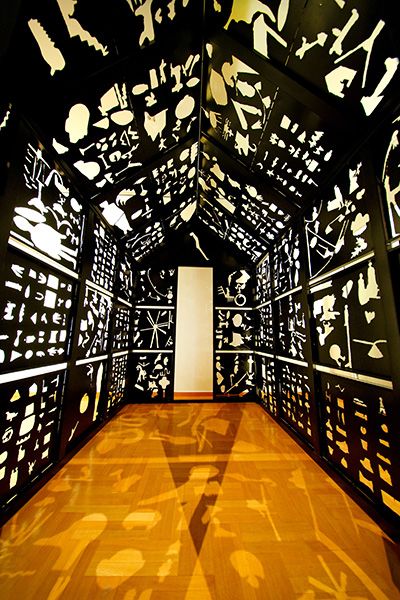
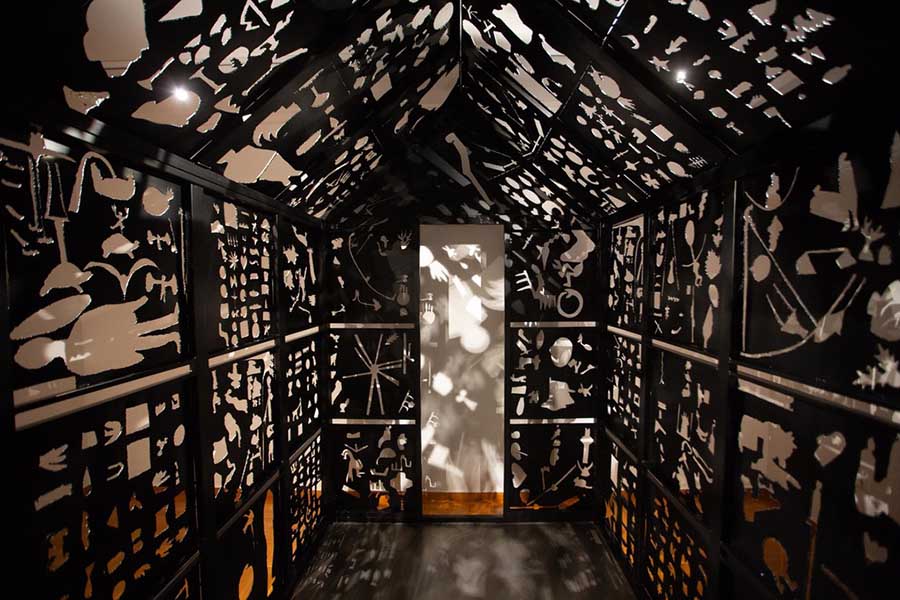
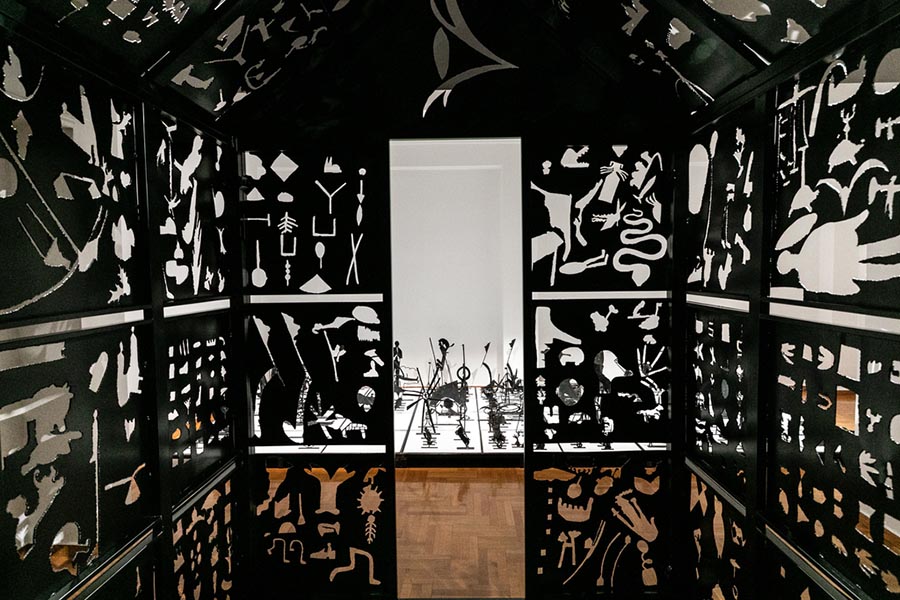
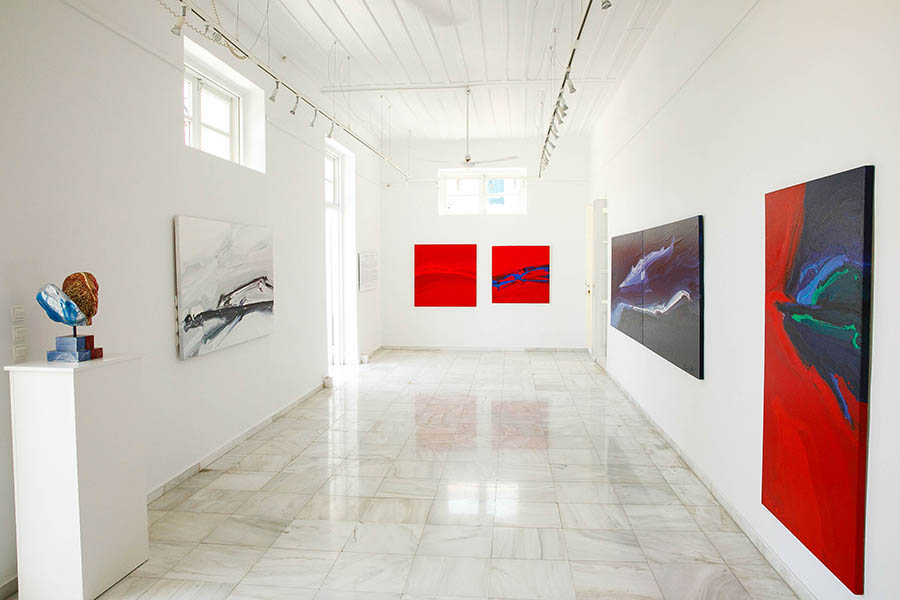
Citronne Gallery, Athens operates in parallel and complementary to the Poros gallery to propose a different art space. In Poros the emphasis is on the local; in Athens, on the global—the interface of world networks. A flat in a 1960s apartment block is converted to meta-function as an exhibition space. On Thursday, November 29, it opens with the exhibition "Encapsulation – Mappemonde" of George Lappas, re-exhibiting one of the best-known and most important works of Greek post-war sculpture, Mappemonde.

Citronne Gallery aspires to achieve a synthesis between local and global, making use of the networks that link the Greek capital with Diaspora and international art. It will display and re-display works that have stood the test of time and function space; that is, works whose symbolism transcends the boundaries of time and space.

True to this spirit, “Mappemonde,” the Map of the World, comes as a delineated, “encapsulated” memory field which is in turn “encapsulated” into the memory of an urban residence. This as charting, a sculptural narrative that starts from personal experiences but at the same time opens up to a universal scale.

As noted by co-curator Yorgos Tzirtzilakis, it is “a work of a mystical nature…, the model of a world with the question of classification at its core... [making] Lappas a latter-day mythologist-sculptor who, in this case, does not so much carve a material with his scalpel but rather constructs, engraves, cuts and above all assembles…”
The 600-page catalogue by Citronne – Athens incorporates the unpublished Secret Book of George Lappas. This precious, hitherto unknown archive material documents the layout of the composition using photocopied photographs, material from the one hundred and sixty-four "plates-casts” (maps), drawings for the three thousand "elements" as well as handwritten notes, catalogue references, calculations and sketches.

Sculptor Afroditi Liti, the life partner of George Lappas, states that “…This was the word of “mappemonde” which was composed of small objects of metal welded together, and a home which took its form from an imaginary quest of his birthplace…”; she believes that “In a scholarly way, through his sculpture, George succeeded in bridging the gaps and obsessions existing between the public and art.” Also, as co-curator Afroditi Liti mentions “after 31 years, and in the space of a hospitable Athenian flat, we are invited to re-appraise, ‘encapsulated’ George’s ecstatic personal map through the stitching together of strewn images of civilization.”

The new venture of Citronne rekindles and builds on an initiative that began twelve years ago. It aspires to enrich the capital’s artistic life with new ideas and fruitful collaborations.

Co-curators & Catalogue Editors
Afroditi Liti, Tatiana Spinari–Pollalis, Yorgos Tzirtzilakis

Lighting
Eleftheria Deko

Catalogue Design
Yorgos Rimenidis – Grid Office

Artworks

The Ambivalence of Memory

Kostas
Paniaras
The Ambivalence of Memory
May 19, 2018 - September 30, 2018
Poros

The theme of this year’s exhibition evokes the inherent identity of a museum, which by definition is the space where memory is preserved and highlighted.

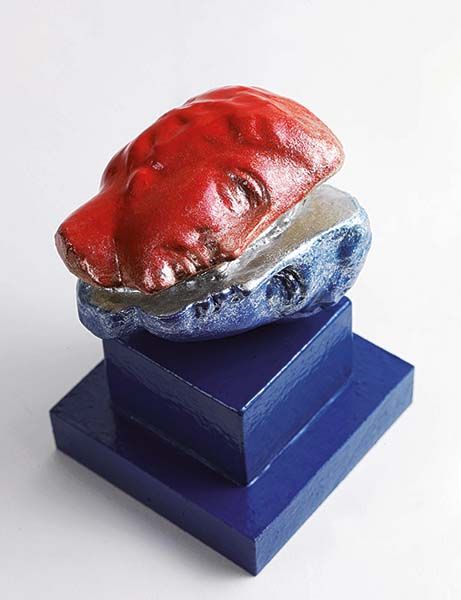
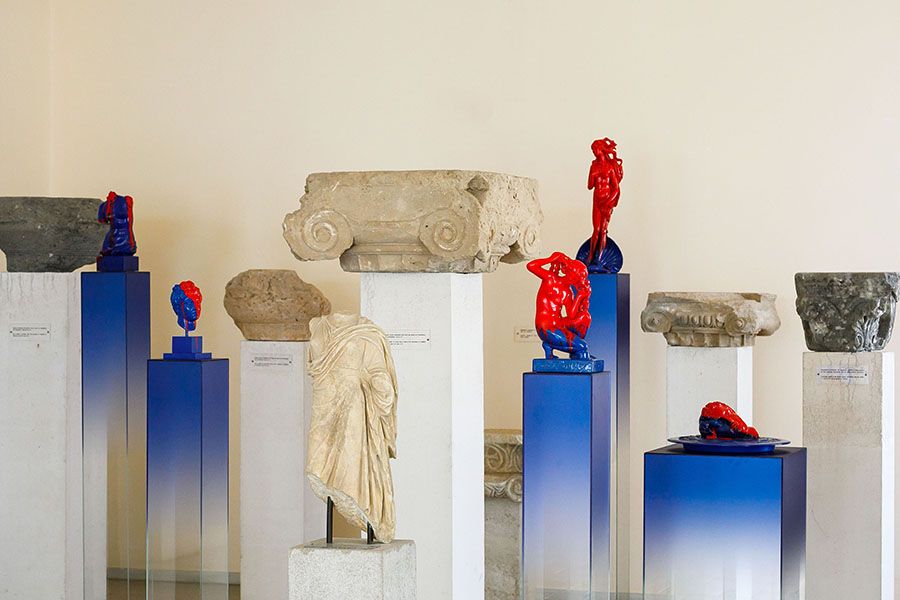
The Archaeological Museum features a group of works overpainted by the artist Kostas Paniaras. These works serve as his personal comments on the museum’s exhibits. The ‘Ambivalence’ of his memory shows through, affirming and treating the ambiguity of history.

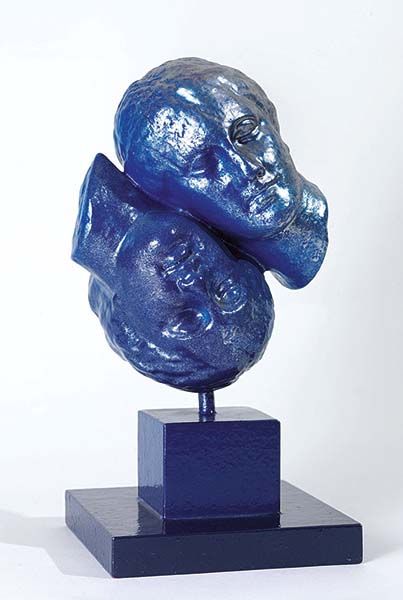
As a Greek artist, Kostas Paniaras strives to deal with a prodigiously large cultural heritage, the burden of a long past. His works have as their starting-point the often abused plaster copies of symbols of antiquity; yet he also begins with authentic museum exhibits. He indiscriminately insinuates himself in all of these: he overpaints them, bisects them, multiplies them. He renders clear, discernible, and recognizable the theme of historical memory and its consequences.

The works by Kostas Paniaras have been selected first on the basis of their ‘archaeological interest’. At the same time however the selection focusses on the treatment of memory — collective and personal — which also often turns tyrannical. The artist’s ‘Ambivalence of Memory’ is reflected in the ‘representations’ of select symbols in which he sometimes multiplies the copies (‘The Memory of Night’, 1984), and sometimes bisects them (‘Day and Night’, 1984). He thus expresses the desire for proud national continuity but also the need to be freed from from the dead weight of history.

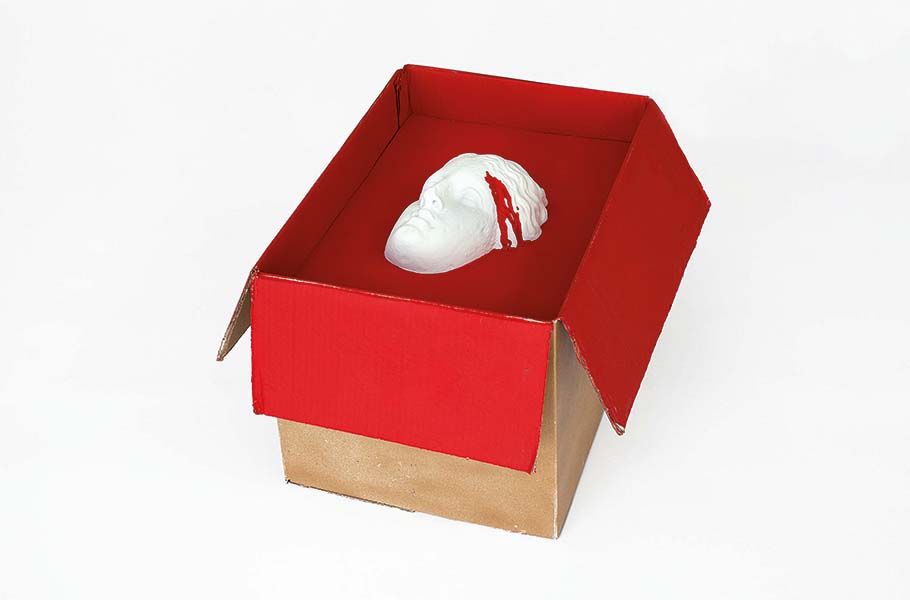
The relationship and dialogue of Kostas Paniaras with the ancient world have characterized his work for many decades. They surface unexpectedly; for instance, the ‘Package for an Unknown Recipient’, a parcel box with a red interior, contains a copy of the head of Hygieia. This work, one of the artist’s last before his death in 2014, suggests the nature of his own questions.

What is more, especially in his recent works he presents the contemporary debates about the uniqueness and incommensurability of a work of art: the question of how images of the most famous, unique, and invaluable works in museums — the landmarks of world heritage — change over time and are conveyed. Thus, the three-part section ‘Aphrodite’ (2012-14) can be assigned to three different sources. ‘Aphrodite III’ starts off from an overpainted, mass copy in sculpted form of Venus rising out of the sea from Botticcelli’s well known Renaissance painting, with its allusions to ancient Greek mythology. The subsequent anonymous maker of the mass object not only copies the original in an arbitrary way, he also changes its identity, turning a painting into a sculpture. In his second Aphrodite, ‘Aphrodite I’, Paniaras has ‘severed’ the head and part of the body; the work has Aphrodite of Melos as its starting-point. A third Aphrodite, ‘Aphrodite II’, takes its cue from Aphrodite of Rhodes, a late Greek adaptation of the famous Crouching Venus of the 3rd century BC. The world famous head of Alexander the Great is represented as an item of food in a deep blue dish — a classic Greek symbol that has changed, having been wounded and worn by time, use and abuse.

As an international Greek artist, Kostas Paniaras searches for the global message of Greece’s cultural legacy. At the same time he strives for a new, private definition, an individual approach to the reality of Greek history. This search is visible and detectable in the works now displayed in the Archaeological Museum.

Artworks

Landscapes of Memory

Kostas
Paniaras
Landscapes of Memory
May 19, 2018 - July 17, 2018
Poros

In Kostas Paniaras’ one-man show at Citronne Gallery, ‘Landscapes of Μemory’ focuses on overpainted replicas and the ambivalent treatment of the cultural past. The exhibition ‘Landscapes of Μemory’ aims at approaching the development of the artist’s aniconic idiom and to bring out the distinct visual and thematic components of his works.

The gallery presents a section which features overpainted sculpture alongside of two-dimensional paintings on canvas and paper. The exhibited works thus belong to his more general artistic production. At any event, the artist regards his overpainted works of sculpture as paintings; that is, in his view the copies of sculpture make up another painted surface. The gallery is therefore showcasing paintings on canvas and on sculpted surface just as he used to do.

The exhibition has three particular sections. The first presents some of Paniaras’ last works, which belong to the large section entitled ‘The View’, a visual retrospective in space and time, with references to his personal memories of landscapes. The sea of the Corinthian Gulf dominates, as also do nature and the sky, mental images of the land of his ancestors.

The second section contains overpainted works of sculpture. The first overpainted sculptures date from the beginning of the 1980’s and treat almost exclusively topics of memory (‘The Memory’, 1984; ‘The Memory of the Night’, 1984; ‘Triple Memory of Sikyon’, 1984). Many of these works reappear in the next decades, for instance, ‘Sebastian’ (1985 and 1993)— at times drastically transformed, like the complete but bisected head of Alexander (1983).

Finally, the third sub-section features early works with fantastic landscapes and abstract forms. It is possible to detect a gradual transition from particular, naturalistic elements to abstraction. These works, little known or entirely unknown in Greece, show the thread of an artistic trajectory culminating in a final phase. In the works from the 1960’s it is also possible to discern the element of ‘randomness’ - actual, specific material that is part and parcel of his artistic creations.

Artworks

Owls

Aphrodite
Liti
Owls
May 19, 2017 - October 31, 2017
Poros

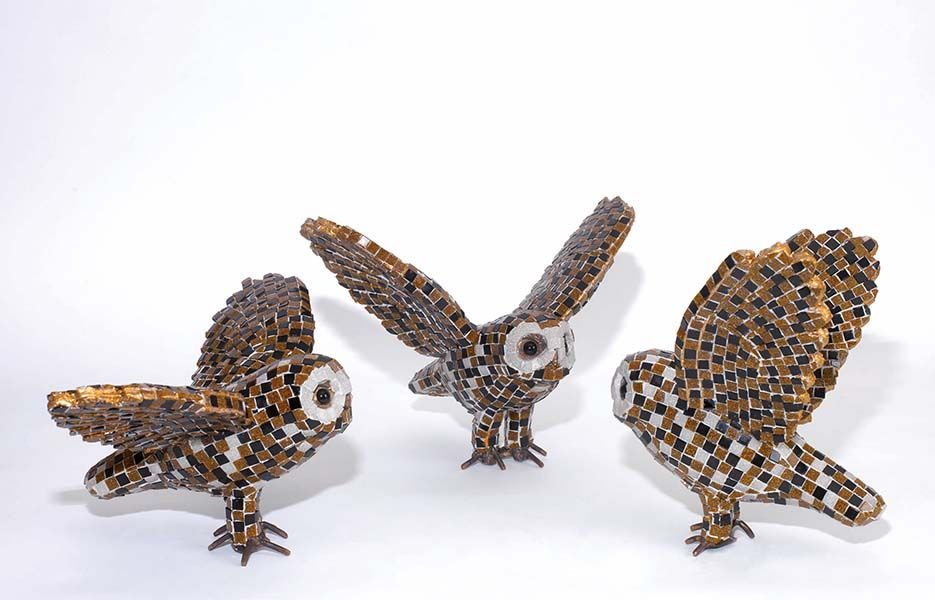
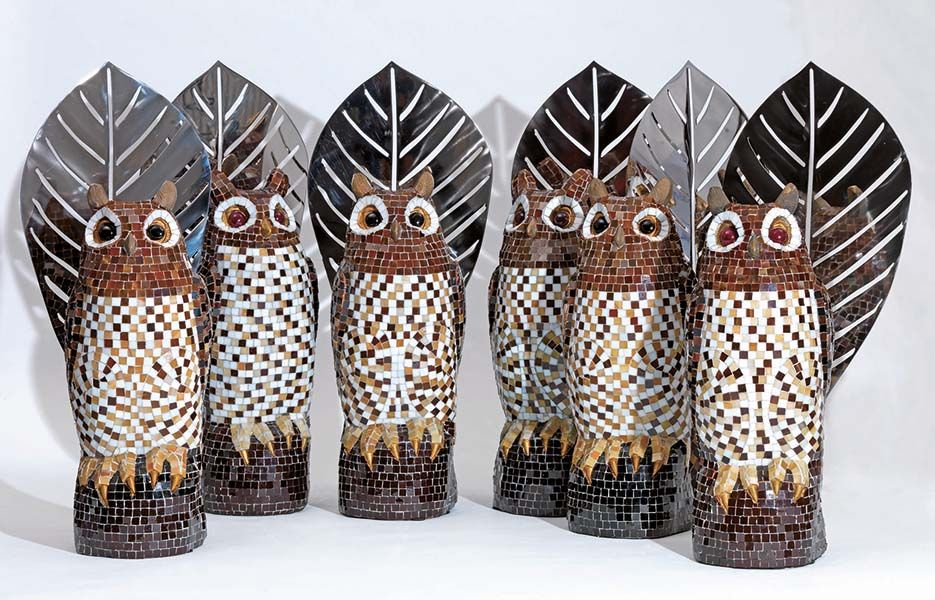
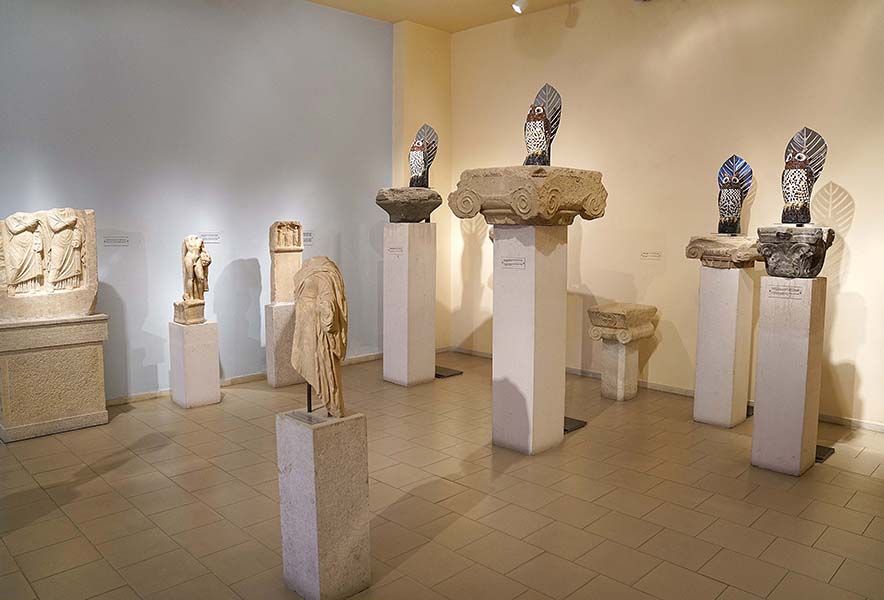
In her ‘Owls’, an installation on show at the Archaeological Museum of Poros, Aphrodite Liti connects mythic with museum time. She not only focusses on the Gaze as a defining characteristic of this bird of wisdom, but also treats it as an allegory of the artistic enterprise. The complex gaze of these birds results in a panoramic vision that unveils and deepens the ‘unseen side of things’. This gaze is not affected by phenomena, it is not misled by daily existence, and most important, it is not restricted by the dark. Linked across time by Nature, Aphrodite Liti’s ‘Owls’ dialogue with the museum’s exhibits in search of a transcendent reality.

The symbolism of the installation of ‘Owls’ stems from two thematic areas: the dialogue between the birds and their conversation with the displays in the museum. The elements— a gigantic leaf and thirteen owls—do not operate as mere figures of the plant and animal world. They become detached from their natural environment, change scale, are unexpectedly juxtaposed afresh, converse, and turn into symbols. Small or oversize, stationary amidst the column capitals or ready to fly off on wide wings from the vases discovered in the sea, these ‘owls’ penetrate space, and unify time.

The process of gazing as a transmitter and and receiver, the creation of an image, and its record in the mind of the viewer, moves on two levels.

The first level is defined by the mythological and ‘natural’ associations of the ‘owl’, its thematics: a nocturnal bird with sharp senses in the dark, with flying motions that are slow and noiseless, with persistence and devotion to aims visible and invisible to man. Night and darkness not only do not hinder its gaze, but on the contrary also eliminate the superfluous elements of luminous reality. This bird thus achieves transcendence, wisdom; elevated, it is suspended in the sphere of the metaphysical.

The second level is defined by the fragmentation of the image. The shattered surface results from a technique that uses the material of coloured tesserae of blown glass from Murano; it also employs a prism as the material for the leaf. The giagantic prism-leaf imports nature as the thematic framework in the museum’s space. At the same time it not only reflects, but also changes the image as ‘in a mirror, darkly’. The light falls, reflects and mirrors the environment creating psychedelic effects. The final impression is that of a fissured reflection that is composed and decomposed, an alternation of images: the museum displays and the contemporary sculpted owls.

The viewer is required to interpret and decode this reflection.

Artworks

Fragments

Αlexandra
Athanassiades
Fragments
September 9, 2017 - October 15, 2017
Poros

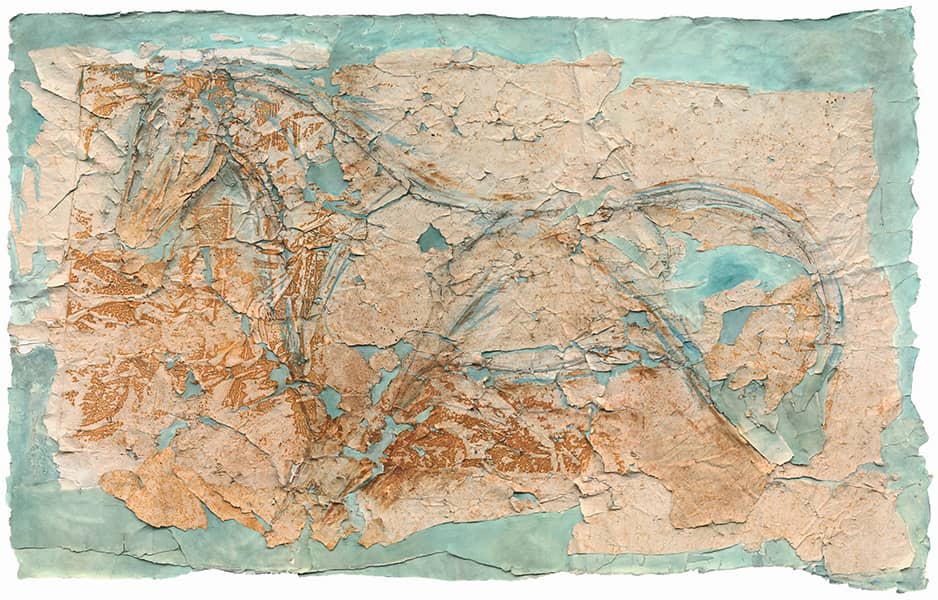
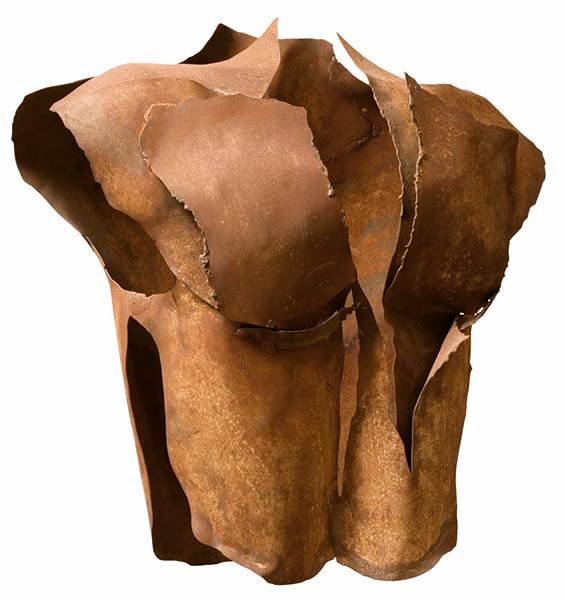
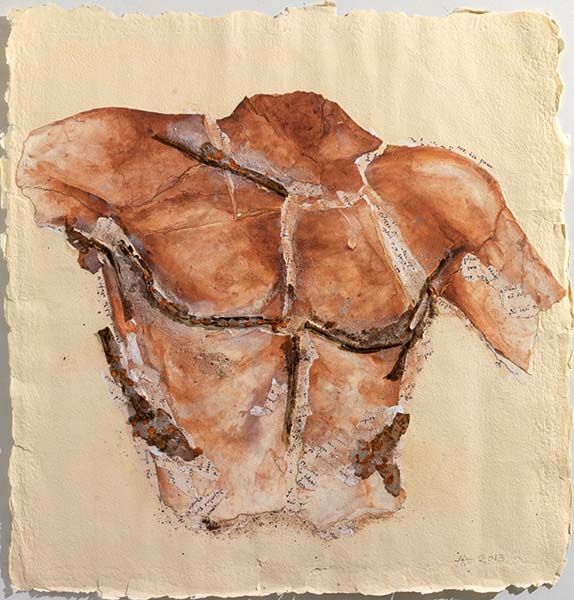
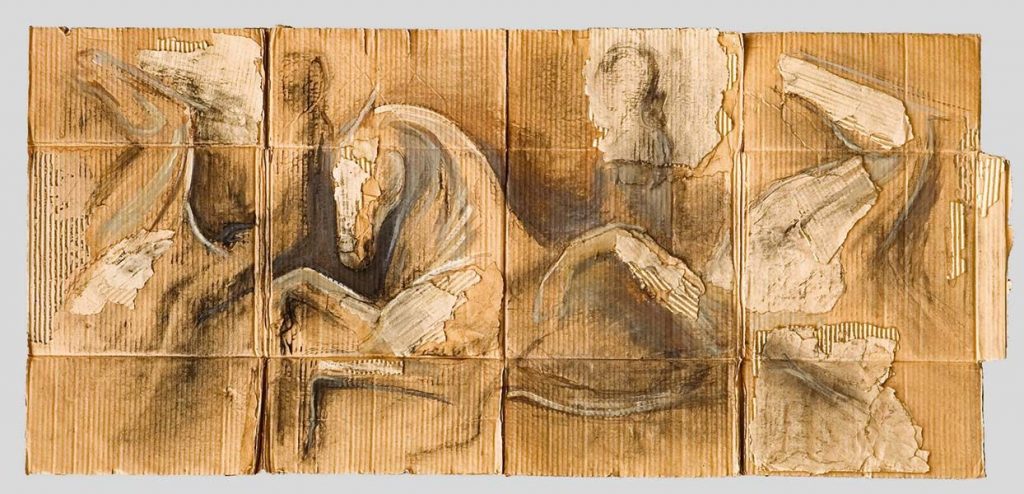
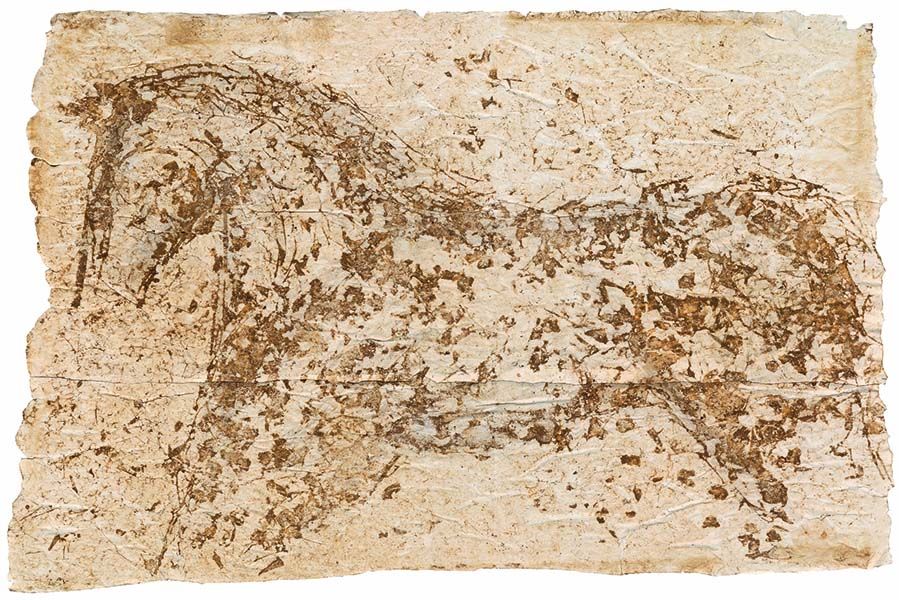
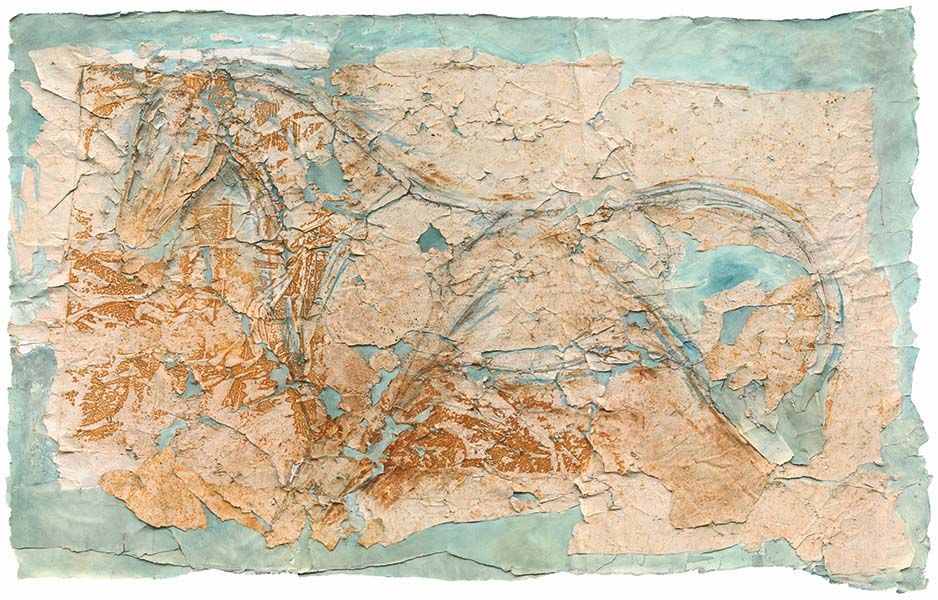
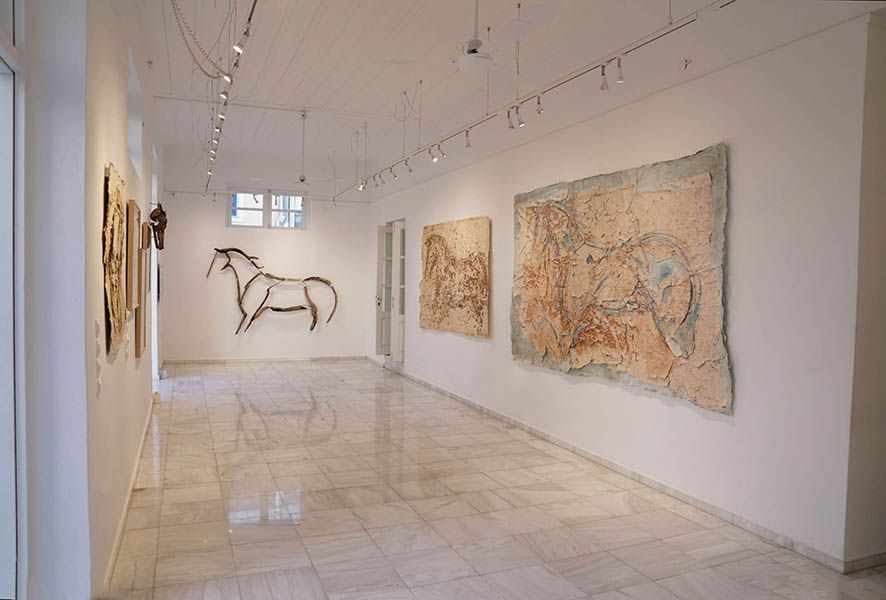
Memory combats decay. Alexandra Athanassiades seeks to introduce the ‘Boundaries of Decay’, to undo the critical effect of time and oblivion. She combines fragments, conjoins impressions, and evokes, gradually and sometimes imperceptibly, the resulting emotions. This exhibition presents for the first time new, two- dimensional works on paper. These are impressions, 'traces' of earlier sculptures. Through this parallel form Alexandra Athanassiades pursues a continual visual dialogue between the materials of Art and the phases of time.

Alexandra Athanassiades focusses on the fragmentary, the disconnected. Decaying matter provides her material: a piece of broken, decomposed wood, the stray part of an ancient sculpture, warped paper, the chance imprint of an older work. Her artistic creations emerge from these ingredients, which are remains or often fragments, in much the same way that human memory works—that is, disjointedly and selectively. The materials create layers and overlayers, like the phases and reminiscences of human life.

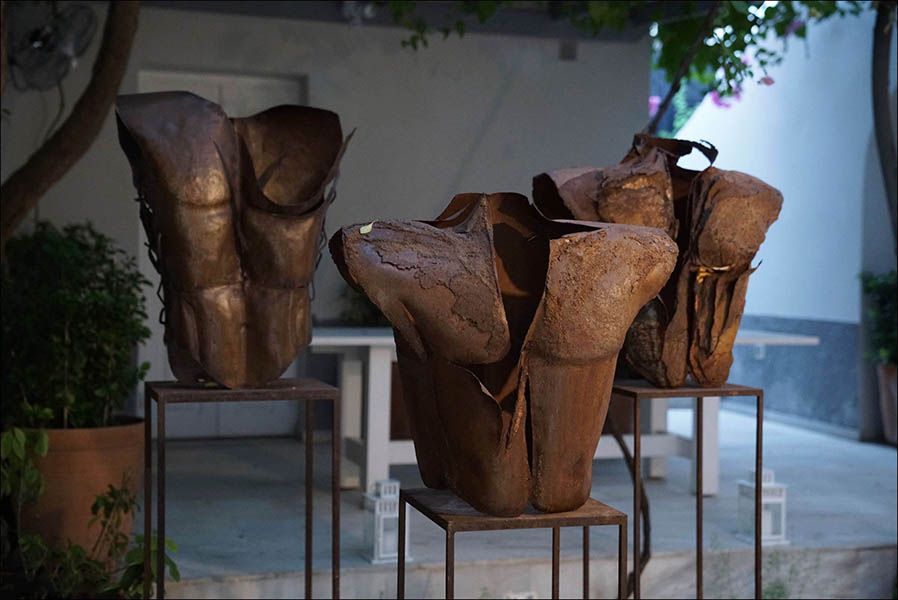
Horses and breastplates—two units—make up the basic theme of the exhibition. This coexistence almost necessarily recalls a diachronic heroic element. From the depths of antiquity, mythology, and history, from epic poetry to folk song it is possible to trace the role and symbolism of the horse: winged Pegasos, the Trojan Horse and so many others. Comrade-in-arms, fellow traveller, man’s helper and supporter, the horse expresses the harmony of body and spirit. Alexandra Athanassiades’ works record this entire trajectory, common or parallel, the coexistence of man and horse.

The breastplates are the second element that Alexandra Athanasssiades brings in from history. A defining part of the defensive arms of antiquity and the Middle Ages, the breastplate covers and protects the vital organs of the body, chiefly the heart. In these representations on paper or metal emphasis is placed on the inexorable passage of time, deterioration, inevitable closure. The human body is vulnerable; no ‘armour’, no external sheathing can protect it forever. Alexandra Athanassiades is dominated by this melancholy thought, which can be detected in the progressive evolution-transformation of the breastplate: the usual museum display, i.e. the closed, impenetrable breastplate, ‘opens up’, leaving human life exposed and unprotected.

This in fact is the basic idea behind all the works exhibited. The external covering, the shell, whether a drawing or sculpture, encases a perishable, assailable entity—personal and charged. Alexandra Athanassiades concentrates on this hidden dimension, on the inner element, which as a presence transcends the boundaries of sculpture.

Artworks